are you an npc?
what separates mediocre masses from the people who aspire to be great
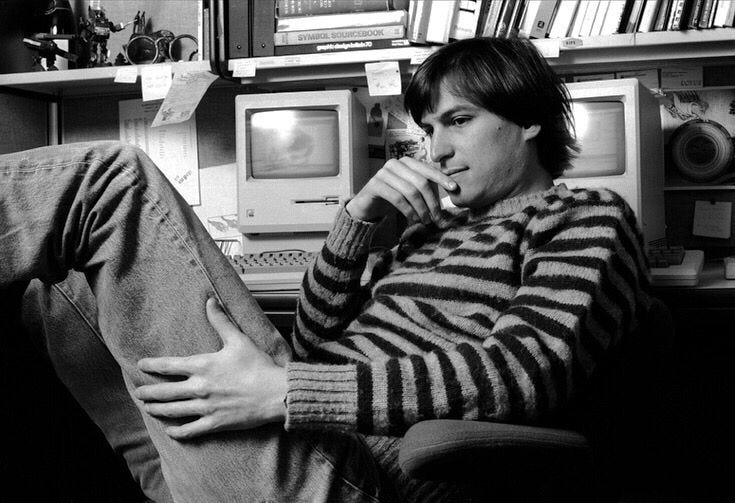
i still remember borrowing the biography of Steve Jobs written by Walter Isaacson from a friend of mine and not returning it for a year. not because it took me a year to finish it, but because my faculty confiscated it after catching me reading during her lecture. once i got it back, i stayed up all night and finished it in one sitting.
the book was compelling enough for a fourteen year to pull this off.
Jobs was an enigmatic person, both for the people who knew him closely and for the people who watched him work afar. but only the people close to him shared the privilege to suffer his antics. his biological mother gave him up, he got adopted by a young couple who pledged to send him to college, and him eventually dropping out of college after discovering that only class he enjoyed was calligraphy, which wasn’t even a part of his course, sets a good premise of how strange he was.
one particular thing which made him different from his contemporary founders at that time in the Valley was that he wasn’t a nerd or any typecast of a person you would see making companies. he was more of a hippie, which isn’t surprising for a 60s teen growing up in California. however, one of the things he repeatedly emphasized upon was the necessity of taste, which evidently reflects in the products of Apple to this day. still remember when he was furious with Microsoft for the lack of taste they showed through their products and the attempt to use Outlook and Windows without crashing out, reinforces the notion even more.
Jobs also had the advantage of location, which he used to fullest extent, like casually walking to the house of an engineer of Hewlett Packard and learning electronics from him and dialing Bill Hewlett himself, asking for parts to build a frequency counter and getting offer to work a summer job at HP at the age of 12.
Jobs’ emphasis on taste didn’t make sense to me when i read about it throughout the book, like why on earth would him and Jony Ive (head of design at Apple) stare at prototypes of iPads which barely looked different from each other except for the radius of their round corner edges. also him getting his eureka moment during the early days of developing Macintosh and noticing that everything in this world is rounded rectangles and nothing more.
such obsession over tiny details won’t make sense to a person whose biggest feat is changing a number in excel sheet. if u truly love creating things: paintings, music, code, products or even anything simple like a knitted scarf, you would relate to this obsession very well. it is less about perfectionism and more about translating the vision you have in your head and meeting with a million tiny hurdles which asymptote you towards the ideal image of your creation. all those tiny iterations and finetuning just don’t seem to be enough. Jobs dealt with the same. he focused more on the product and pushed engineers to extreme limits just to execute that vision, even if it meant innovating out of necessity. that’s one of the reason why he wasn’t particularly liked by his team as he would simple barge in, look at their progress, call it shit, and leave without an explanation.
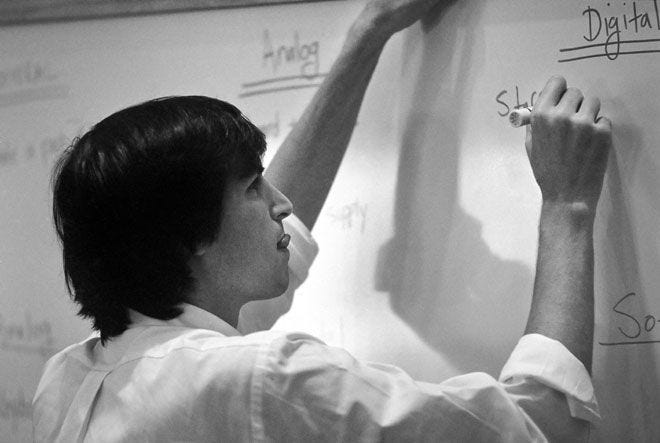
but where does this obsession stem from? maybe from the ambitious little dream crafted by the tinkerers of your taste. but where does taste come from? it isn’t innate or implanted, but rather a symphony of both. every piece of content you consume, from books to texts to places you visit, to people you have conversations with, to the uncomfortable situations you witness helplessly are a fodder to your taste. but what’s more important is what you make from theses arrays of stimuluses. and that’s what makes you stand apart from someone who measures achievements with money.
unfortunately, taste can’t be manufactured, it simply reflects the canvas of your self. the interests you choose to have with some agency against the regular, bleak stream of people, and being quietly unapologetic about them. taste matters more than the skills you train your brain to move in a desired direction of life, as it shapes your daily moments, which eventually compound into a creation of yours.
when Jobs was fired from Apple, by a CEO who previously worked at Pepsi, he went on to create Pixar, which was just a tiny team experimenting with computer animation. the creativity reflected in Pixar movies is an evidence of Jobs’ unconventional ways of dealing with things. he insisted upon creating a common lobby from where the building diverged so that people would bump into each other a lot, which would lead to more conversations, exchange of ideas and eventual creation of best animated movies ever.
you can’t copy someone’s taste as it would never fit in the contraption of your persona. the exact state in which you are right now has a million variables which you might not have gotten the chance to decide, which then command the choices you make, culminate into the taste you develop. a sign of a person with good taste lies in his ability to try new things even if they are deemed unconventional by his current state.
with the advancement of AI, things have become a lot cheaper, code, design, information. what makes human-made things stand apart from “AI slop” is a just refactored component of taste. a nuance morphed into a design choice, which makes it unique and one of its kind. with time, what will matter is how your products become actually useful to clients and not how complex your code is. the skill to design better products will outweigh the ability to write boilerplate all night long.
even in code, taste matters. a problem can be approached in several ways. A tasteful programmer resists adding the clever abstraction, the extra config option, the premature generalization. they write the simplest thing that solves the real problem, and no more. bad taste tends toward over-engineering, building a framework when a function would do. the engineer who developed the video game Roller Coaster Tycoon entirely in assembly had a particular vision and it’s execution warranted a fail proof architecture which he found possible in assembly.
having read about the shifting importance from skill to taste in this age of AI made me recollect Steve Jobs’ life and his philosophy, which surprisingly stays relevant even after fifteen years of his death and in this new age of humanity. such timeless figures are worth studying and admiring, a small incident of his life can inspire you to do much more than you find yourself capable of.